Here's a trivial example using both generators, and built in functions to acheive the same result:


 I've started work on the walkthrough mentioned in my previous post. It doesn't touch on topics such as searches of the completed tree, but sticks to the theory behind the creation and balancing of the resulting tree.


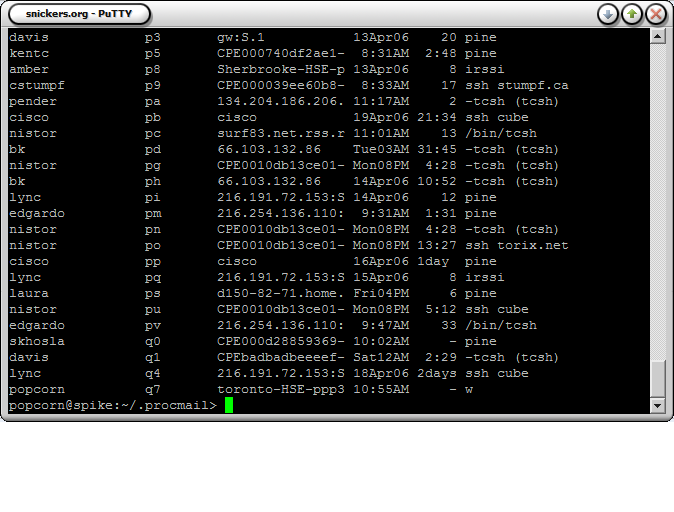 Now, that hostname belongs to Rogers internet, and they (appear to) use a combination of strings and hex values to denote their customers' address.







If a variable is not final then it should be private. If you need to make it accessible to another class and there is no accessor then you're probably not doing something right.
I don't think C gets enough credit. Sure, C doesn't love you. C isn't about love--C is about thrills. C hangs around in the bad part of town. C knows all the gang signs. C has a motorcycle, and wears the leathers everywhere, and never wears a helmet, because that would mess up C's punked-out hair. C likes to give cops the finger and grin and speed away. Mention that you'd like something, and C will pretend to ignore you; the next day, C will bring you one, no questions asked, and toss it to you with a you-know-you-want-me smirk that makes your heart race. Where did C get it? "It fell off a truck," C says, putting away the boltcutters. You start to feel like C doesn't know the meaning of "private" or "protected": what C wants, C takes. This excites you. C knows how to get you anything but safety. C will give you anything but commitment
In the end, you'll leave C, not because you want something better, but because you can't handle the intensity. C says "I'm gonna live fast, die young, and leave a good-looking corpse," but you know that C can never die, not so long as C is still the fastest thing on the road.
"You start to feel like C doesn't know the meaning of "private" or "protected": what C wants, C takes. This excites you. C knows how to get you anything but safety."
Basically, someone resuming from an exception handler can never be sure that the code after the point of throw was written to deal with the excecution just continuing as if nothing had happened. An exception handler cannot know how much context to "get right" before resuming. To get such code right, the writer of the throw and the writer of the catch need intimate knowledge of each others code and context. This creates a complicated mutual dependency that wherever it has been allowed has led to serious maintenance problems.This is probably of very little interest to many people, but I find it rather facinating to see why certain decisions were made.

